Our new Advanced Imaging Center offers world-class PET/CT scans in a calm, outpatient atmosphere designed for your comfort.
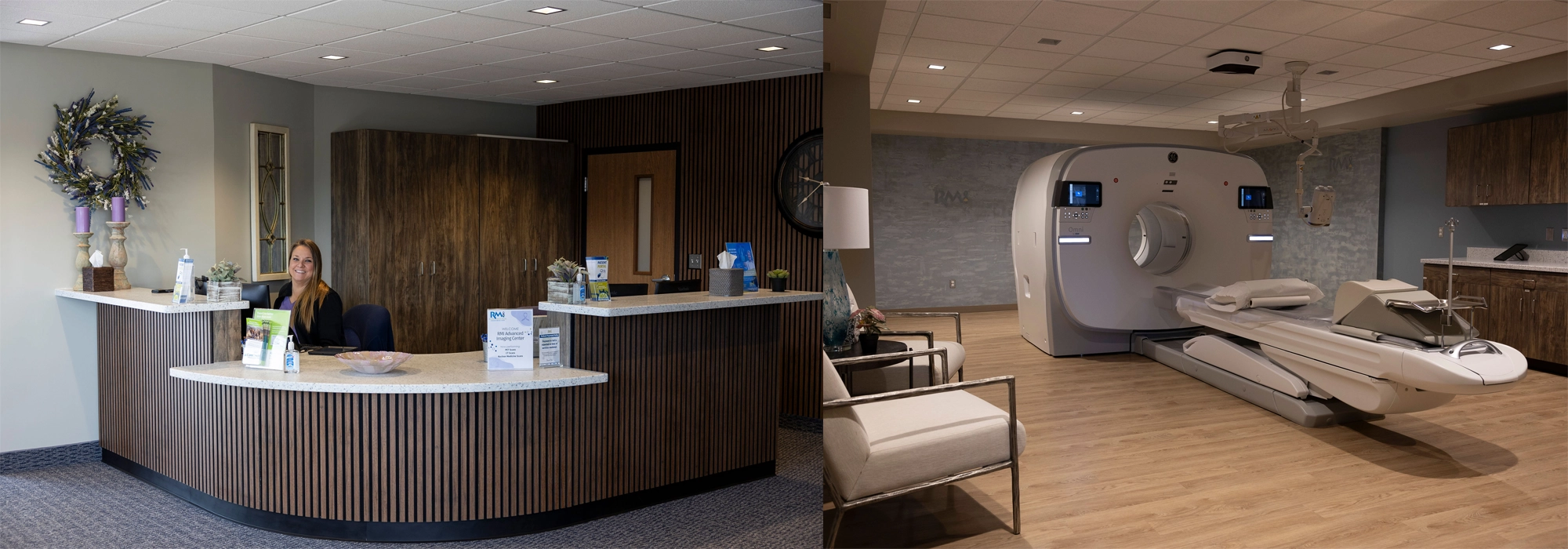
For your next PET/CT, skip the hospital! RMI is the only independent imaging center with a permanent fixed indoor PET/CT in Michigan!
What does this mean for patients?
- The newest, industry-leading PET/CT technology
- The first in-site PET/CT scanner—NOT in a trailer—for more standardized
imaging quality - More comfortable outpatient environment
- Less wait time for appointments; Available 5 days/week; greater flexibility
- Offering the most recent, specialized radiotracers to improve tumor
detection and guide treatment - Care supported by leading-edge technology and experienced staff
- Special protocols to alleviate delays
We’re excited to welcome patients to our new center!
PET/CT
What is PET/CT?
A PET/CT scan is a procedure that actually uses two different imaging approaches to enable radiologists to look for signs of disease or other problems within the body and to evaluate how organs of the body are functioning: positron emission tomography (PET) and CT (computed tomography).
In the PET scan, the patient is injected with a small amount of radioactive material that circulates through the bloodstream, making tissues and organs of the body, as they function, visible to the imaging equipment.
The CT scan uses X-rays to image sections of the body so that the radiologist can see organ structures or indicators of disease.
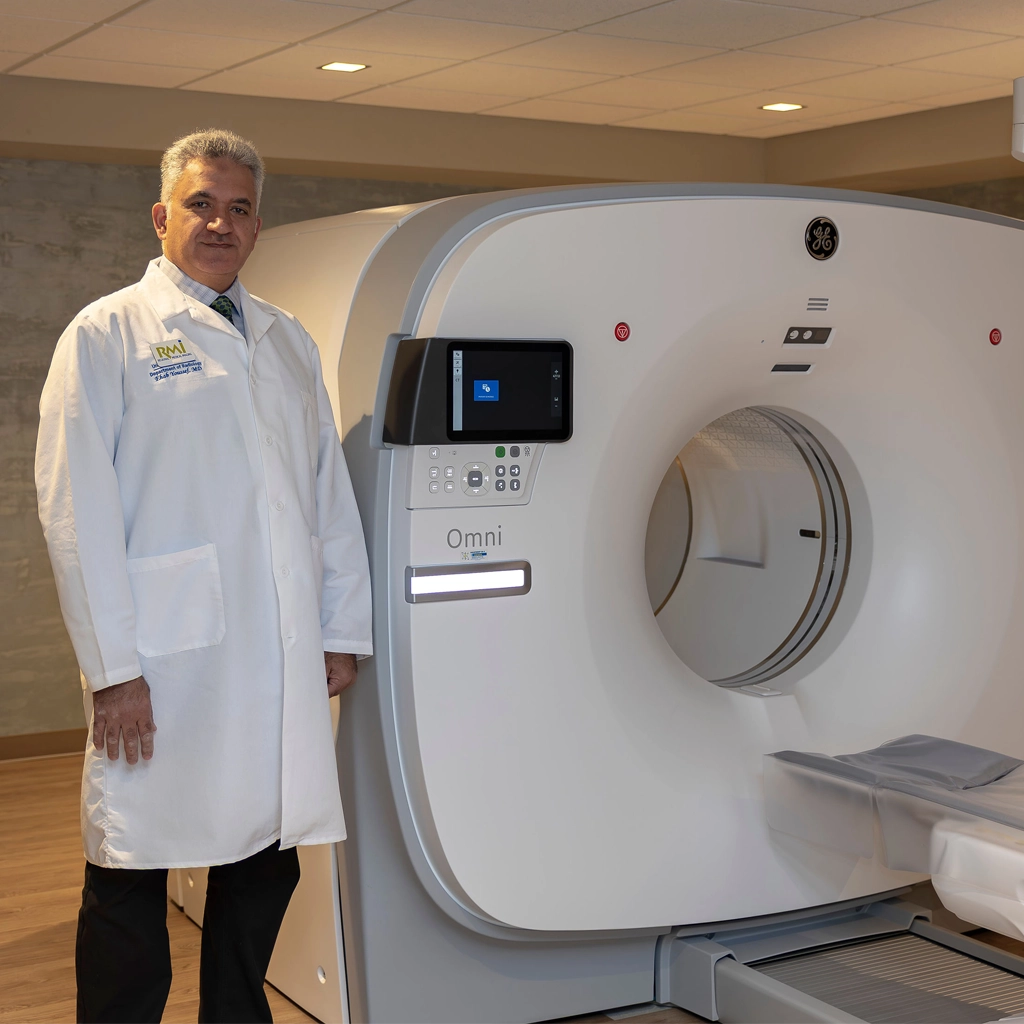
Dr. Ehab Youssef, a double board-certified radiologist with triple fellowship training, is the Director of the PET/CT Imaging Program at RMI.
Think of the PET scan as creating images that show organs as they are functioning over time, whereas the CT scan creates more of a snapshot of what a section of the body or an organ looks like at a specific instant.
Your physician may order a PET/CT scan for different medical reasons, depending on your specific condition. At RMI, there are three main areas where PET/CT is used:
ONCOLOGICAL IMAGING
For patients with suspected or confirmed cancer, PET/CT is used to identify tumors, assess the extent of disease (cancer staging) and to help evaluate treatment response. A whole-body PET/CT can be used to find out if cancer has metastasized to other areas of the body. It can also help guide therapy, which is why it is sometimes used in preoperative planning before surgery or to guide biopsies.
NEUROLOGICAL IMAGING
PET/CT is also used to evaluate brain metabolism and function, along with the brain’s anatomical structures. An amyloid beta scan is a type of neurological PET/CT scan to measure the amount of amyloid plaques within the brain that are associated with memory and thinking issues; the scan can help accurately diagnose or rule out neurodegenerative disorders (such as Alzheimer’s disease). PET/CT may also be used to diagnose conditions such as epilepsy, brain tumors and other dysfunction within the brain. It is also used to assess changes over time in response to treatment.
CARDIAC IMAGING
By combining functional and anatomical imaging, PET/CT is often used to understand how blood is flowing through the heart. It can identify areas of reduced blood flow associated with coronary artery disease. It can also help assess the health of the heart muscle (myocardial viability) in order to determine if the heart is capable of recovering function and restoring blood flow.
Preparation
A PET/CT scan uses very small amounts of glucose (sugar) to make images within the body. The foods you eat affect your blood sugar, which in return may affect the quality of the exam. We have enclosed this list of instructions to help ensure that you have the best possible blood sugar on the day of your scan.
Please click here to download a PDF of the preparation instructions »
Required diet to be followed day prior and day of the exam:
- An all meat, eggs, cheese diet ONLY.
- Only drink water. You must be well hydrated.
- Do not eat carbohydrates. This includes potatoes, pasta, rice, breads, chips and pretzels.
- Do not eat cookies, candy, fruit, drink soda pop, alcoholic beverages, coffee or any other beverages containing caffeine.
- Your blood sugar must be between 50-200 in order for us to complete your scan.
- Do not consume any food or drink 6 hours before your scan this includes candy, gum, mints, cough drops and all tobacco products.
- Readi-Cat: (contrast beverage; can be picked up at any of our locations).
- Drink one full bottle of Readi-Cat (barium sulfate) 2 hours prior to your arrival time.
- Absolutely no food or drink after drinking the Readi-Cat.
- We suggest chilling the Readi-Cat.
- Patients taking steroids (i.e. Prednisone, Dexamethasone, Decadron) must discontinue this medication 24 hours prior to your appointment.
- Insulin dependent patients must discontinue Insulin 4 hours prior to your appointment.
- Patients taking Metformin must discontinue this medication 24 hours prior to your appointment. Your blood sugar must be between 50-200 in order for us to complete your scan.
- All other medications can be taken as prescribed by your physician.
- Avoid all strenuous activities and exercise 24 hours prior to your exam.
- Patient cannot have chemo treatment 24 hours prior to appointment.
- We suggest dressing comfortably and in layers to stay warm as the exam rooms are kept cool.
- Please avoid any clothing with large buttons, zippers or any other metal objects on them.
- Suggestions: sweatpants, sweatshirt, pajama pants.
What to Expect
After checking in, our staff will check your blood sugar level and you will be injected with a small amount of radioactive sugar. Then, you will be required to sit or lie down for 45-60 minutes. An interview process will take place to obtain your medical history. The actual scan will take about 30 minutes. Please plan on being at the office for approximately 2 hours.
Failure to follow the instructions listed above will result in cancellation of your appointment. You will be responsible for a $175.00 cancellation fee. If you need to cancel or reschedule your appointment, please contact us at 810-244-7100 no later than 24 hours in advance.
Medical Radiation Safety
The radiation doses from a PET/CT scan is considered to be in the “low-level radiation” category. However, since PET/CT scans require more radiation than other types of imaging exams, RMI is committed to managing radiation dose for patient safety, under the principles of the Image Gently program for pediatric patients and the Image Wisely program for adults.
Resources
RadiologyInfo.org: Positron Emission Tomography – Computed Tomography (PET/CT)